
Guide
That Noise Your Garage Door Is Making, Explained
A guide for Fremont homeowners on garage door noises, tied to this area's 1955-2005 housing stock, mild climate, and neighborhoods from Niles to Warm Springs.
Local detail
When Waiting Is Fine
Not every sound means a call tonight. A single soft thump when the door closes on a cold morning is usually just the rollers settling into worn track - common on the original steel doors still hanging in neighborhoods like Mission San Jose and Glenmoor, where houses date back to the 1960s and 70s. If the door still opens and closes on the first try and the noise doesn't repeat mid-cycle, you can watch it for a week or two rather than book a service call.
A light squeak at the hinges that goes away after you spray a little lubricant is maintenance, not failure. Fremont's mild temperate climate means we don't get the freeze-thaw cycling that cracks hardware fast in colder regions, so a door here tends to degrade slowly and predictably rather than fail overnight. That's the honest limitation worth knowing: most noise complaints we see aren't emergencies, and pushing a same-day call for a sound that's been stable for months usually isn't worth the money.
Track the noise. If it's the same pitch, same moment in the cycle, same door position every time, it can wait for a scheduled visit.
The area
What Is Going On
Grinding on the way up almost always points to a roller or bearing losing its coating, and it shows up more in this area's older housing stock (median build year 1966, F1) because original hardware from that era used steel rollers rather than the nylon ones installed since. A loud bang followed by the door refusing to move is a different animal - that's a spring, and it's not a wait-and-see item. Rattling that seems to come from the wall near the opener is often the travel screw or the drive gear, parts that wear out on schedule in houses built across the 1955-2005 span this area covers.
A low hum with no movement is usually the motor capacitor giving out, not the door itself. None of these are exotic. They show up in roughly the same order in nearly every house from Warm Springs to Niles that's still running its original garage door setup, simply because so much of this area's housing landed in the same twenty-year construction window.
What we find
What to Check
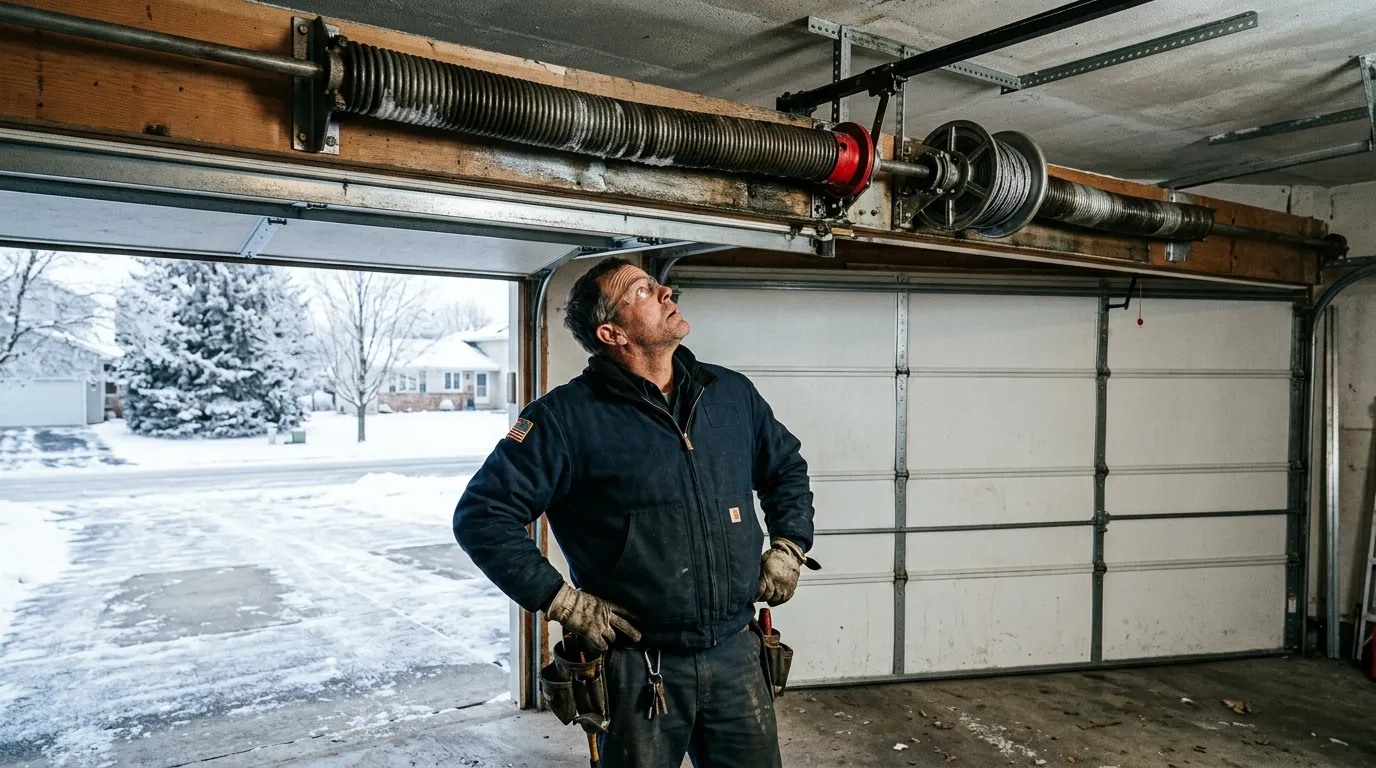
Start by looking at the springs above the door - if one looks stretched or has a visible gap in a coil, stop opening the door by opener or by hand and call, because a broken torsion spring under tension is the one thing on this list that can hurt someone. Next, watch the rollers as the door travels; wobble or a roller that looks flat on one side needs replacing before it jumps the track. Check the track brackets are still tight against the framing - with houses in this area averaging 1966 construction, it's common to find brackets that have loosened over decades without ever being retightened.
Listen for where in the cycle the noise happens: top of travel, bottom of travel, or the whole way through, since that tells a tech more than describing the sound itself. Finally, check the weatherstripping at the bottom panel. It won't cause noise, but Fremont's mild climate means many owners never think to replace it, and a curled, brittle strip is often the first visible sign a door is past its expected service life.
How we work
How Local Conditions Play In
Fremont doesn't put doors through the extremes that shorten hardware life elsewhere - no deep freeze, no heavy humidity swings - and that mild temperate pattern is why a lot of doors here are still running original springs and rollers decades after installation. The tradeoff is that owners in older sections, from Central District to Kimber-Gomes, often assume a quiet-running door means nothing is wearing, when in fact steel rollers and single-lifespan torsion springs from a 1966-median build wear on a clock, not on climate stress. Newer construction toward the edges of the 1955-2005 range tends to have nylon rollers and better-sealed bottom panels, so the same noise means something different depending on which era of the neighborhood you're in.
If you're not sure which category your house falls into, the panel style and roller material are usually enough to place it. We don't do cosmetic panel matching for doors this old - if a section is dented, it often can't be color- or texture-matched to the rest of a decades-old door, and replacement of the full door is the straighter answer at that point.
Questions
Common questions
My garage door only makes noise on humid mornings, is that normal here
Fremont's mild temperate climate means big humidity or temperature swings aren't common, so a noise tied closely to weather is more likely wood-panel swelling on an older door than a hardware fault. If it disappears once the day warms up, it's worth mentioning at your next visit rather than an emergency call.
Is grinding always a spring problem
No. Grinding is more often a roller or bearing, especially in houses from this area's 1960s-70s stock that still have original steel rollers. A spring problem usually sounds like a bang, not a grind, and comes with the door refusing to move afterward.
Why does my neighbor's newer door sound different from mine
Housing in this area spans 1955 to 2005, so a door built near the newer end of that range likely has nylon rollers and updated seals, which run quieter than the steel rollers common on original doors from the 1966 median build year.
Ready when you are
Need a garage door sorted in Fremont?
Fremont Garage Door Pros repairs and installs garage doors, springs and openers in Fremont, CA and the surrounding area.